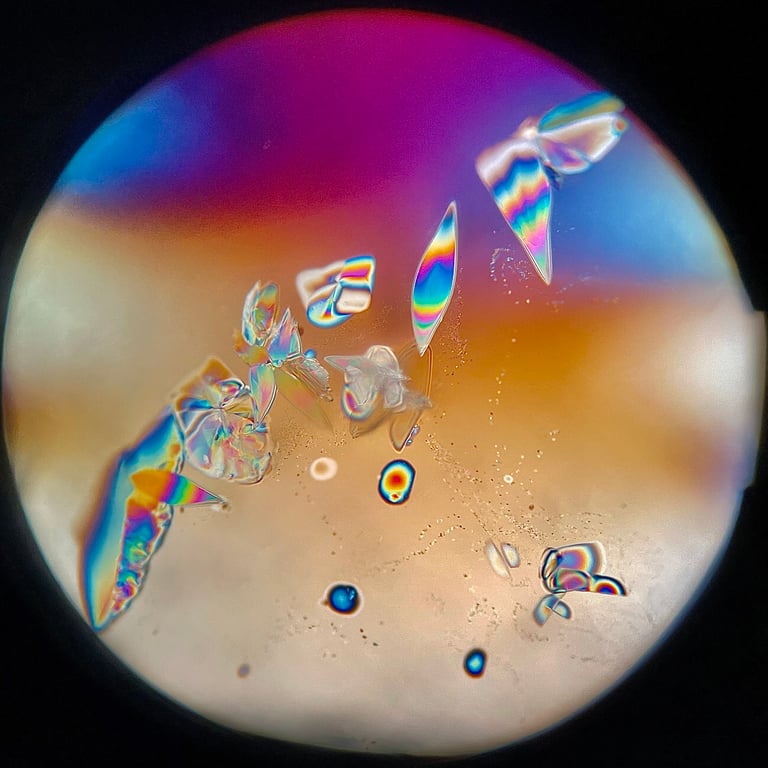
“IMG_1393” (Evaporated wine crystals)
Her response was short and memorable:
What a cool photo! It is art! No one wanted the microscope, so we can set a time for you to take it home.
I had created art many times before I got this message, but this was the first time that
external validation came with enough art supplies to start a home studio. It was time to start introducing myself as an artist.
Life is so beautiful in that way. Certain things just align and allow you to see yourself in a new light. It seems like that microscope was meant to be yours and I'm glad that experience allowed you to start introducing yourself as an artist. Since then how do you think your artistic style has evolved over time?
My style evolves every time I teach myself to use another tool. The first images I captured on the little scope Kabir brought home were all brightfield, meaning the light passes right through the sample. The image is the shadow the sample casts on the eyepiece, and the colors you see are the wavelengths that don’t get absorbed. I improvised a light source with an LED flashlight that I bought off Amazon in a 5 pack.
I slowly figured out how contrast and
lighting could make almost anything interesting, then experimented with hand-cut plastic filters to add color with cross-polarization. When I rebuilt the big 'broken' scope, I found way more than I bargained for! Not just optics for brightfield and cross-polarization, but darkfield, DIC, phase, and even fluorescence if I could get the mercury lamp working. Giddy with possibilities, I reached out to a fellow microscope scientist for optical advice. His first question:
What lab did you get this from again?
Which I responded, Greider Lab, sixth floor, why do you ask?
He then exclaimed, Why!? Martín, Carol Greider won a Nobel prize for discovering how telomeres work! That microscope probably contributed images to that research.
Jaw, meet floor. Knowing that the hardware was capable of Nobel-level work raised my own expectations for what I could do behind the eyepiece.
That's incredible and honestly a bit surreal! With that kind of legacy behind the instrument and all those new possibilities in front of you, what inspires your creative process?
The natural world is a bottomless source of inspiration, and it’s the first place I go back
to when I hit a creative barrier. Every hike in the woods or trip to the inner harbor reminds me that we’ve just scratched the surface of understanding and appreciating living things. At the same time, my best work has been inspired by other people.
My friends and family regularly
bring me bugs, leaves, and ideas in the hopes that something they found will make a great image. My favorite collaboration was “Burning Bubbles,” a reel of red blood cells dissolving in peroxide that featured an original song by my sister Aura. With microscopy there’s always another sample and not enough time, so I’m never satisfied, but I’m also never bored!
If you’re interested in an artistic collaboration, please reach out to bmore.micro.art@gmail.com .
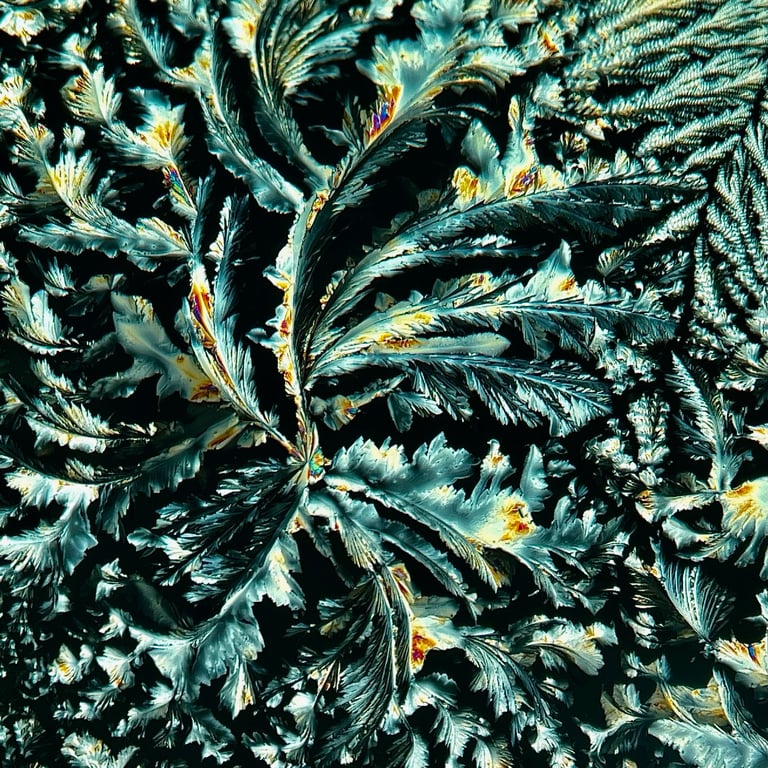
“Fractal Dream” (Vitamin C Crystals)
What does your day or week as an artist usually consist of, whether you are part-time or full-time ? Walk me through it.
I’m a full-time scientist and a part-time artist. In both worlds, it makes sense to carve out entire days for imaging. You cut and cover your samples while they’re still fresh, adjust the pieces of the light path, and lock the slide into place on the stage. You dim the lights and push the sample into focus, taking smaller steps the closer you get to your target.
At home or in lab, microscopy rewards creativity and discipline. Where art and science diverge is in the composition of the image. In science, you purify, simplify, extract, and measure. You collect 100 grayscale images to answer a single yes or no question. When I make my art, I often spend hours asking questions about one sample: What lenses will make everything but the petal and its pollen disappear? What camera settings will bring out the rich hidden colors? What fine digital edits will capture not just the shapes I saw, but the movement I felt?
You’ve described living between the worlds of art and science, especially at a time when it felt like you had to choose one path. In what ways has your upbringing influenced your confidence in pursuing your artistic vision?
My mom always supported my art. Even when she was working two jobs, she still made time to go to my high school theater shows. She didn’t understand the jokes, but she was proud to see me on stage. Mom always said, “I don’t care what you choose to do, as long as you try to be the best at it.” She also blurred the line between art and science as an industrial engineer who first visited Europe as part of a cumbia dance troupe. My mom died of pancreatic cancer in April 2022, so she never got to see my microscope art - but she would have liked the images with red
in them.
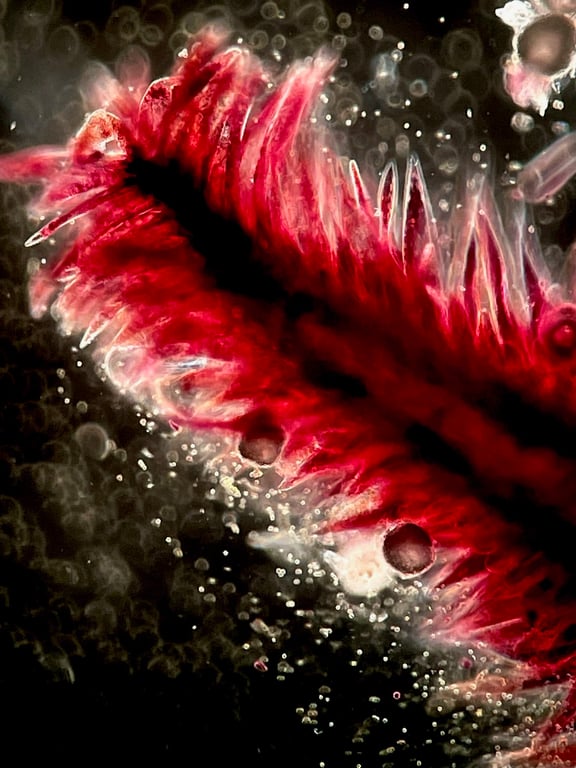
“Sunflower Secret” (Sunflower stigma)
Your mother sounds like an incredible woman who was dedicated to supporting her children, and it seems like she had quite a journey of her own as well. Even though she isn’t here to see your work today, it feels like her influence is still very present in what you create. Your original artwork is so unique and I wonder if there is particular project or piece of work that you are especially proud of? What makes it stand out for you?
I have a special place in my heart for Kaiju, my three-color image of a dandelion flower.
It’s unfiltered autofluorescence under UV excitation, meaning no dyes were added and all colors are produced by the flower’s natural chemicals.
The intense red inside most of the cells comes from chlorophyll, the blue glow is from the cell walls, and the bright green-yellow is from concentrated flavonoids in specialized cells. I was incredibly lucky to get three strong colors with overlapping patterns in a single sample. It also happens to look like a radioactive sea monster
roaring its tiny heart out, which is so fun in contrast to the flower’s ordinary innocence.
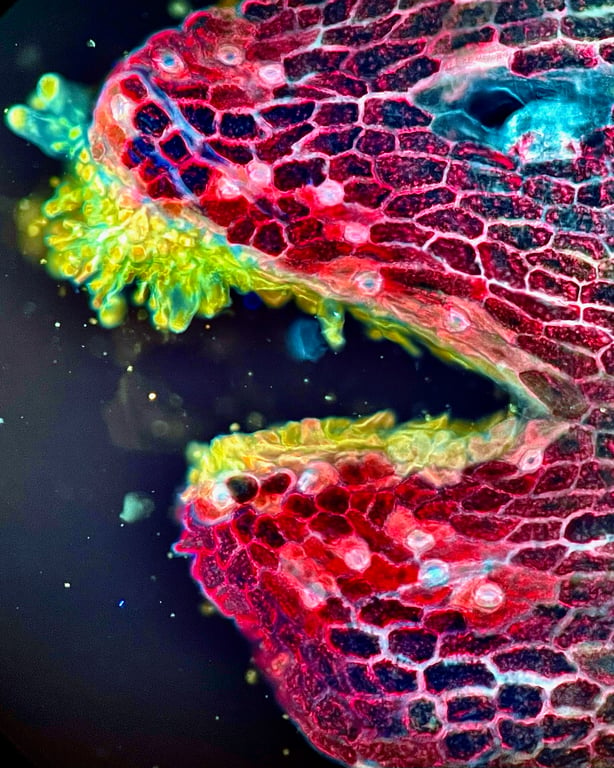
“Kaiju” (Dandelion flower)
Your artwork uniquely bridges art and science. What draws you to that intersection, and how has exploring it influenced your worldview over time?
For me, the bridge between art and science is the use of perspective. In both worlds, you have to reveal a side of something that no one’s seen before. Growing up as a Colombian immigrant has made me good at bridging perspectives since before I knew there was a gap between art and science. Over time, the microscopy has taught me to see wonder in unexpected places.
Honestly, I think the gap between art and science says more about how society labels people than what people are actually capable of. We sort kids into 'creative types' and 'logical thinkers' while their minds are still curious enough to become absolutely anything. In my
experience, art and science not only intersect but reinforce each other. Understanding the world makes it easier to magnify its beauty, and striking visuals make it possible to communicate any theory. Don’t let anyone call you left-brained or right-brained. Use your whole brain - paint with precision and write elegant code!
I really appreciate that perspective, especially the idea that art and science can reinforce each other rather than exist separately. It’s a powerful reminder not to limit ourselves. With that in mind, what advice would you give to an emerging artist who’s trying to market themselves?
Your art is about more than color and composition—it's about telling a story that will get a stranger emotionally invested in your work. My friend Edgar has taught me a lot about this. A
few months after he joined me as a collaborator, we made the leap from hobby to side hustle, and from handwritten captions to gallery-quality prints. It was not a fast process. We explored
many techniques before landing on a formula that turned admirers into customers. This meant evolving: complementing my phone camera with a DSLR, printing on different mediums, and testing various framing compositions. We ran experiments that took time to fully realize their potential, and changed the variables that worked online but not on paper.
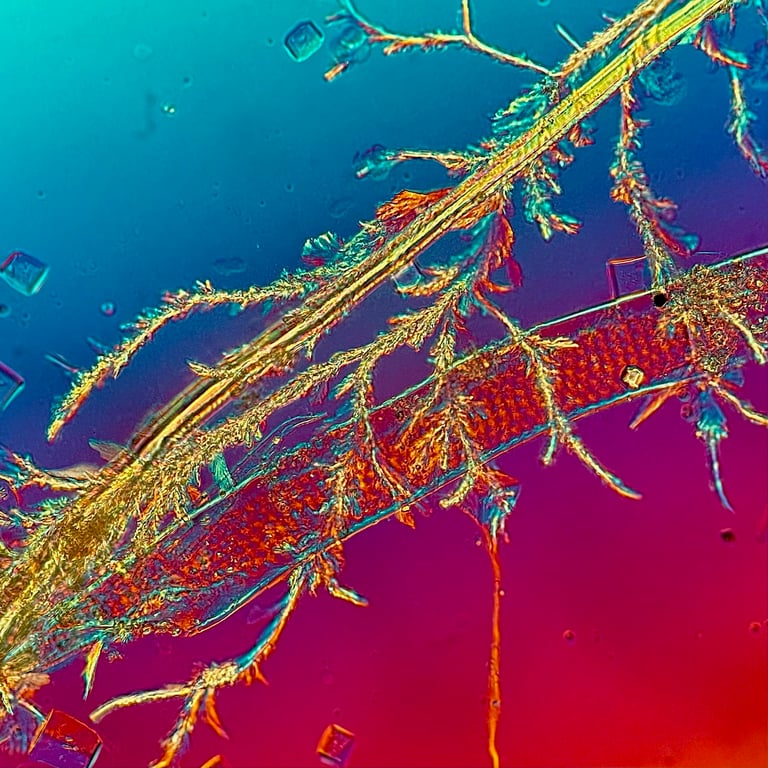
“Fault lines” (Myoglobin crystals)
Importantly, we also found an early market in our existing audience - other researchers
connected with our work because it reflected their inner journeys of scientific exploration. Making that emotional connection is about communicating through art those feelings that have no way of expressing themselves with words. Finding your artistic voice requires experimentation, so my advice to emerging artists is to try every lens, track what resonates, and don't be afraid to pivot. If you want to talk more about my artistic journey, come by our tent at Artscape! 100 Holliday Street, May 23rd-24th, 11AM–10PM
We are seeing more and more artists using social media as a way to connect with their audience. How has social media helped expand the reach of your art?
My partner Cece was the one who first suggested I make an instagram account for my microscope pictures. At first, the account was just a fun way of showing images to close friends
and family. Then colleagues and comrades started sharing my posts, and the audience grew organically. One image landed on the cover of a science communication zine called Charm City Science, which opened doors I didn't know existed.
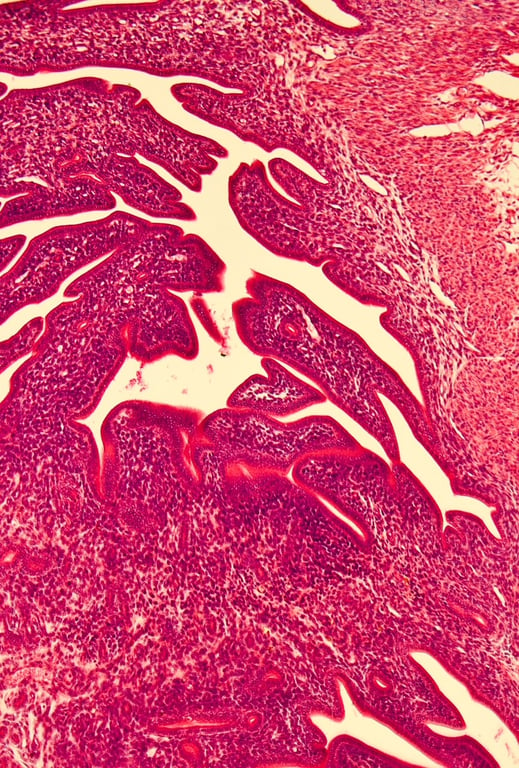
“Mystery Slide” (A rodent's uterus)
My favorite social media moment was
posting 'Mystery Slide', an image of an unlabeled tissue sample my friend Nico rescued from another lab cleanout. A histologist in Tasmania commented identifying it as a cross-section of a rodent's uterus, demonstrating how global and generous the microscopy community can be. I write bilingual captions so that my friends in Colombia can follow the microscope journey, and I always pack some prints when I go back home. Social media is not the reason I’m an artist, but
it is the reason people around the world can enjoy my art.
I have certainly enjoyed your art and will continue to be a fan! You're doing something pretty incredible here Martín and I hope you continue to make strides on your journey and make your mom proud. Before I let you go, I'm curious what’s a song you’re currently listening to on repeat, and why?
Ojalá - Silvio Rodriguez. Me encantan las canciones melancólicas que realmente son historias cortas, y que transforman el significado de las palabras que usan.
-----------------------------------------------
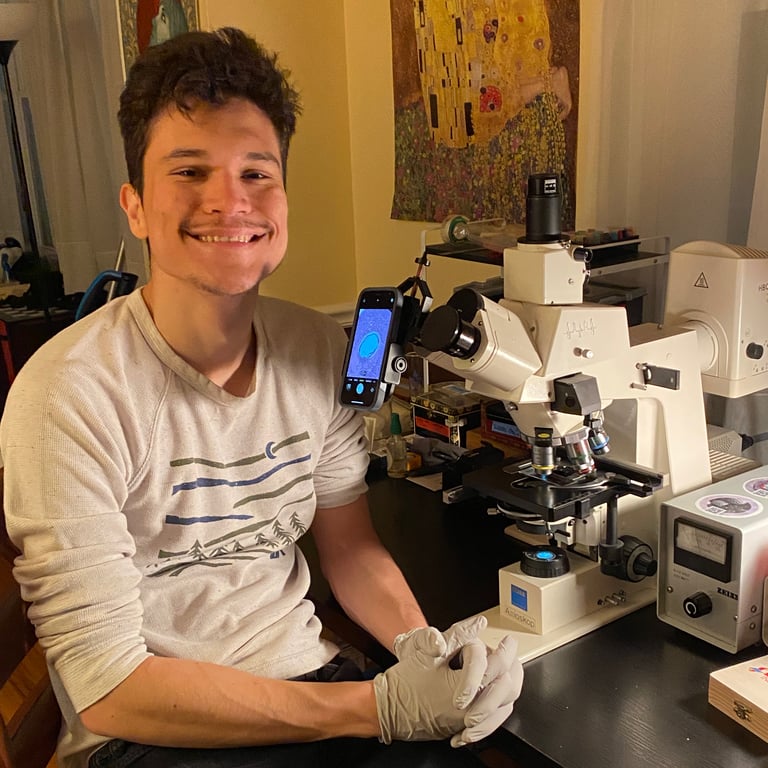
Portrait photo of Martín with microscope
To learn more about Martín’s journey, his original art, or for collaborations, be sure to connect with him via instagram (@bmoremicro) or via email (bmore.micro.art@gmail.com)! Be on the lookout for his next projects and come by his tent at Artscape: 100 Holliday Street, May 23rd-24th, 11AM–10PM, if you're local!
*If you're an artist (of any discipline) interested in being featured in this spotlight series, please send an email to inquiries@leonella97.com.
Léonella © 2025